Kanagawa, Japan – Sigma Corporation (Headquarters: Kawasaki-shi, Kanagawa, CEO: Kazuto Yamaki) is pleased to announce that Sigma, in collaboration with JINS Inc. (the eyewear brand JINS), has provided technical cooperation for the creation of CAMERA MAN, a work featured in the exhibition “HIROSHI SUGIMOTO: EXTINCTION,” held from Tuesday, June 16 to Sunday, September 13, 2026.
This exhibition, taking place at the National Museum of Modern Art, Tokyo, showcases approximately 60 silver halide photographs by contemporary artist Hiroshi Sugimoto, who is active in various fi elds, from his early works in the late 1970s all the way up to the present day, representing the origins of his art. His works, based on a fi rm concept and featuring unique expressions, represent the pinnacle of silver halide photography technique, and in this age of digital photography, his techniques are truly “on the verge of extinction.”
Marking his first solo museum exhibition in Japan composed entirely of photographic works since the 2005 Mori Art Museum exhibition, a satellite exhibition featuring all of Sugimoto’s works from the museum’s own collection, along with the Sugimoto Notebooks which reveal the secrets of his artistic process, will be held in the Collection Gallery on the third floor of the museum.
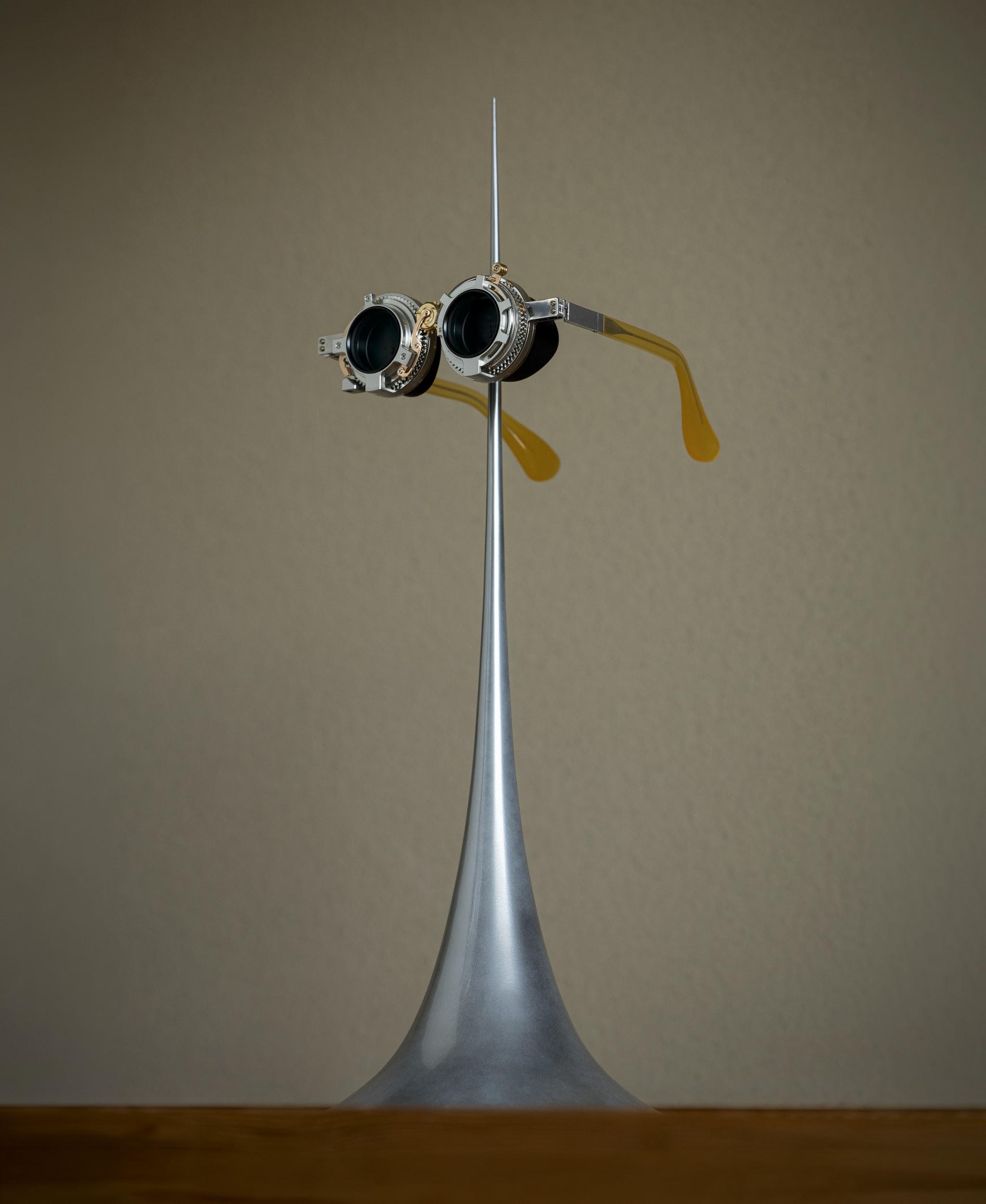
One of the exhibited works, CAMERA MAN, was developed based on Hiroshi Sugimoto’s concept that “a camera is a device that reflects the structure of the human eye.” By manually pressing the shutter of a glasses-type camera with a shutter speed of 1 second, after 3 minutes of darkness, a 1-second exposure of the outside world is exposed and saved on the retina (the film of memory). By fusing the technology and design capabilities that JINS has cultivated as an eyewear brand with Sigma’s manufacturing and advanced processing technology for optical products, they have embodied a “human camera” that is as if a shutter were built into the human eye.
Concept for the artwork CAMERA MAN by Hiroshi Sugimoto
A camera is a device that reflects the structure of the human eye. The lens is the crystalline lens, the aperture is the pupil, and the film is the retina. However, unfortunately, the human eye does not have a shutter. Therefore, I conceived of a human camera by incorporating a shutter into the human eye. The shutter speed is set to 1 second, and the shutter is pressed by the user through a shutter release. Before that, three minutes are spent in darkness. Then, for a fleeting moment, a 1-second image of the outside world is exposed on the retina. The outside world floats on the retina and is stored on the film of memory, but the image deteriorates quite quickly, although this varies from person to person. As a metaphor, I likened one second to a human lifetime. If the average human lifespan is 85 years, then these three minutes represent the passage of time of about 15,000 years. This roughly coincides with the time it took for humankind to develop consciousness and progress towards civilization. I devised this device to allow people to experience the length of time of civilization by likening it to a human lifetime.
About the Exhibition
HIROSHI SUGIMOTO: EXTINCTION
Tuesday, June 16 – Sunday, September 13, 2026
10:00 – 17:00(Fridays and Saturdays, 10:00 – 20:00)
Closed on Mondays (except July 20) and July 21
Venue
The National Museum of Modern Art, Tokyo
Special Exhibition Gallery (1st floor)
https://art.nikkei.com/sugimoto/
About Hiroshi Sugimoto
Born in 1948. Moved to the United States in 1970, and from 1974 started producing work while shuttling back and forth between New York and Japan. His early best-known photographic series are “Dioramas,” “Seascapes” and “Theaters.” He founded an architectural practice, New Material Research Laboratory, in 2008, and established Odawara Art Foundation in 2009, before opening Enoura Observatory in 2017, a cultural complex that took 10 years from conception to completion. At The Hawk’s Well, a dance production he directed and set-designed was performed at the Opéra National de Paris in 2019. Awards include the Hasselblad Foundation International Award in Photography (2001); the Praemium Imperiale for painting (2009); and the Medal with Purple Ribbon (2010). He was made an Officier de L’Ordre des Arts et des Lettres in France in 2013, selected as a Person of Cultural Merit in Japan in 2017, and elected as a member of the Japan Art Academy in 2023.
About JINS
With the vision of “Magnify Life”, JINS is Japan’s leading eyewear brand with the highest annual sales volume in the region*, serving people of all ages and backgrounds. Each store constantly features a diverse lineup of approximately 1,200 styles, ranging from timeless classics to the latest trends. JINS continuously pursues innovation to enrich people’s lives through products created in collaboration with world-renowned designers and architects, as well as the development of cutting-edge services utilizing AI. As of May 2026, the brand operates 870 stores globally, including locations in Japan, China, North America, Taiwan, the Philippines, Hong Kong, Vietnam, and Mongolia.
* Net Sales Comparison Among Major Japanese Eyewear Retailers Based on Full-Year Consolidated Financial Results (as of November 2025, according to Tokyo Shoko Research).
About Sigma
MADE IN AIZU, JAPAN “The Art of engineering. Engineering for Art.”
Sigma is a Japanese manufacturer of lenses and cameras. Founded in 1961, we innovate and push the standards of optical engineering out of a deep respect for the creative ways photographers and filmmakers engage with the world. Made in Aizu, Japan is made possible by Sigma’s sole production base, the Aizu factory in Japan. This quality embodies the true essence of Sigma–an integration of local wisdom, craftsmanship, and technology.